Local Business Web Design Inspiration: Why Galleries Miss It
Why showcase galleries skip the dentists, cafes and law firms designers build for, what that costs, and where to find local business web design inspiration.
7 min read
Open the front page of any big design gallery and count the plumbers. Or the dentists, the cafes, the accountants, the law firms on the high street. You will be counting for a while. For anyone looking for local business web design inspiration, the most popular galleries on the web are close to useless, and it is worth understanding why, because the reason is not that good local business sites do not exist.
This is not a complaint about those galleries. They do what they are built to do very well. It is an argument that what they are built to do is a different job from the one most designers have on their desk, and that treating them as the standard quietly costs designers, clients and the craft itself.
How showcase galleries actually work
A showcase gallery is fed by submissions. Agencies, studios and designers put forward their own work, and on the biggest of them, Awwwards, entering a site for its daily and annual prizes costs a fee per site. A jury then scores what comes in.
That model shapes everything you see on the front page. The people who enter are the people who have a reason to: studios building a reputation, designers building a portfolio, product companies launching something new. The sites they enter are often made with being featured in mind, with the budget, the freedom and the time to try something nobody has tried yet.
Then the judging rewards exactly that: originality, craft, technical ambition. A scroll effect nobody has seen before scores well. A beautifully set type system scores well. A phone number that sits in the same place on every page does not score at all, because there is nothing to judge.
None of this is wrong. It is how you get a gallery full of experimental, ambitious, often brilliant work. But it means the gallery is a record of what gets entered and what impresses a jury, not a record of good websites in general.
Why local business sites never make it in
Three things keep local business sites off those front pages.
Nobody enters them. The owner of a dental practice has never heard of a design gallery. The freelancer who built the site has moved on to the next client. Even when the work is excellent, no one has a reason to pay to put it forward.
Their best qualities do not show up in a showcase. The things that make a local site work are mostly quiet: the phone number that is always in the header, the opening hours stated before anything else, the booking button that is never more than a thumb away, the menu set as real text instead of a PDF. You only notice them when they are missing. In a gallery that rewards what stands out, the parts that work best are invisible.
They are built under real constraints. The photography is usually the owner’s own. The content has to be edited by someone who is not a designer. The site has to load on a patchy connection outside a busy shop. Good local work turns those constraints into decisions, and the result can look plain to a juror while being exactly right for the customer.
What it costs
If showcase galleries were only one source among many, none of this would matter. But for a lot of designers they are the default reference for what good looks like, and that has consequences.
Designers learn from the wrong examples. Effects that suit a product launch end up on a dentist’s homepage: a loading animation before the phone number appears, navigation hidden behind an unusual gesture, a hero that is all atmosphere and no information. They look impressive in a portfolio and get in the way of the person trying to book.
Clients get the wrong expectations. Show a café owner a showreel and they will ask for one, with content and a budget that cannot support it. The conversation should be about calls, bookings and trust, and it starts somewhere else entirely.
Good local work goes unnamed. Because no one collects it, no one describes it. There is a shared vocabulary for scroll-driven storytelling and none for the best way to show a service area or publish a call-out fee. Skills that are not named are hard to teach and easy to undervalue.
Local work starts to feel like the lesser job. If every celebrated site is a launch or a showreel, it is easy for a designer early in their career to conclude that building for a roofer is what you do until you get to do the interesting work. It is not. It is some of the most demanding design there is, because the customer has a real problem and about ten seconds of patience.
Two sites a showcase gallery would pass over
Here are two examples of the kind of design that rarely gets entered anywhere, and is exactly what a designer with a local client needs to see.
Cumulus Inc.
Restaurant
Made with SquarespaceCaptured
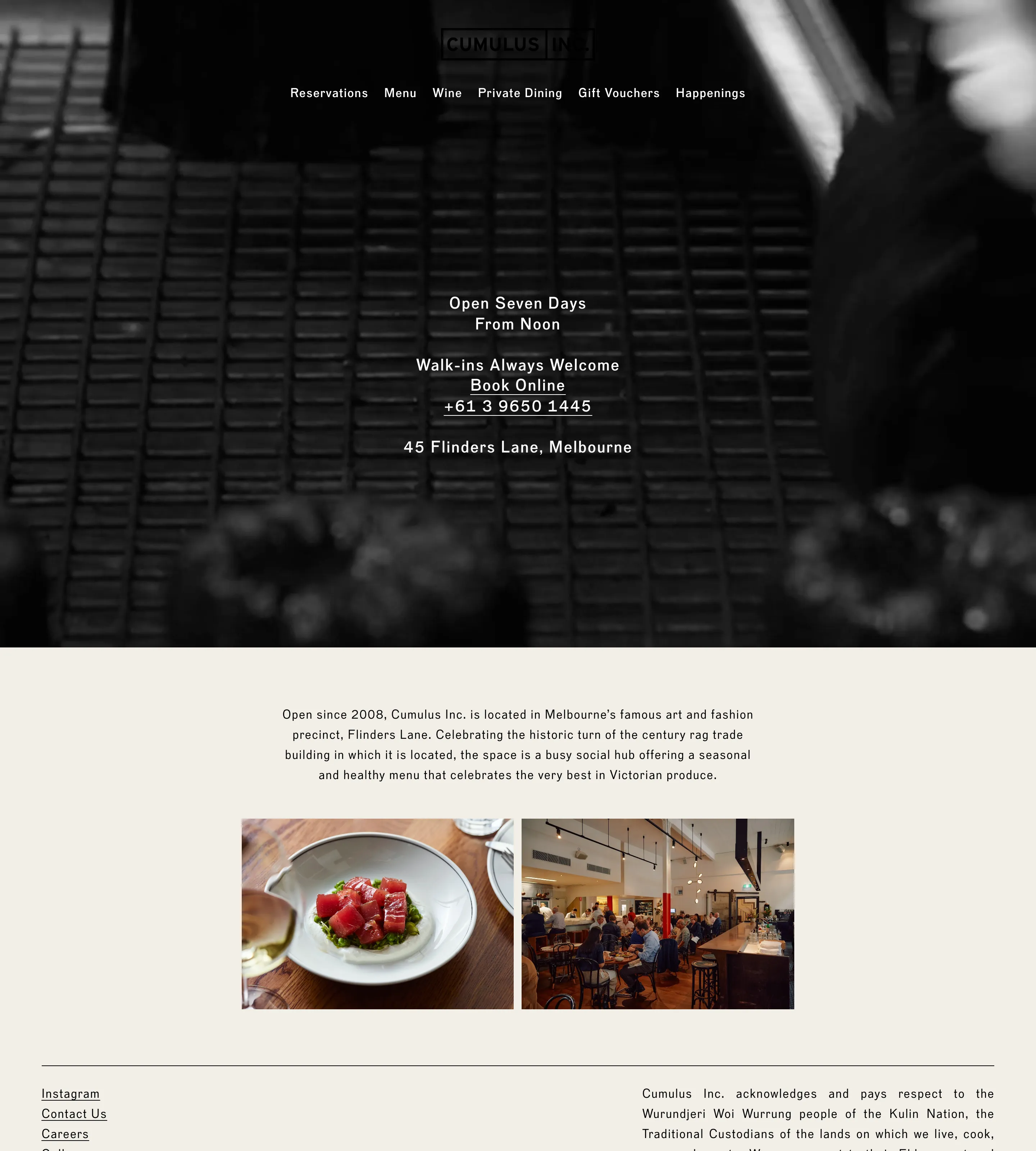
Cumulus Inc., Melbourne. The homepage of this restaurant barely has a headline. Over a dark, near-monochrome photo, the hero simply lists what a diner needs: open seven days from noon, walk-ins always welcome, a link to book online, the phone number and the address. Nothing else competes. Below it, a short paragraph, two photos and the footer. In a showcase it would read as almost nothing. For someone standing on the street deciding where to eat, it is perfect.
Oliver & Co
Legal
Made with CustomCaptured
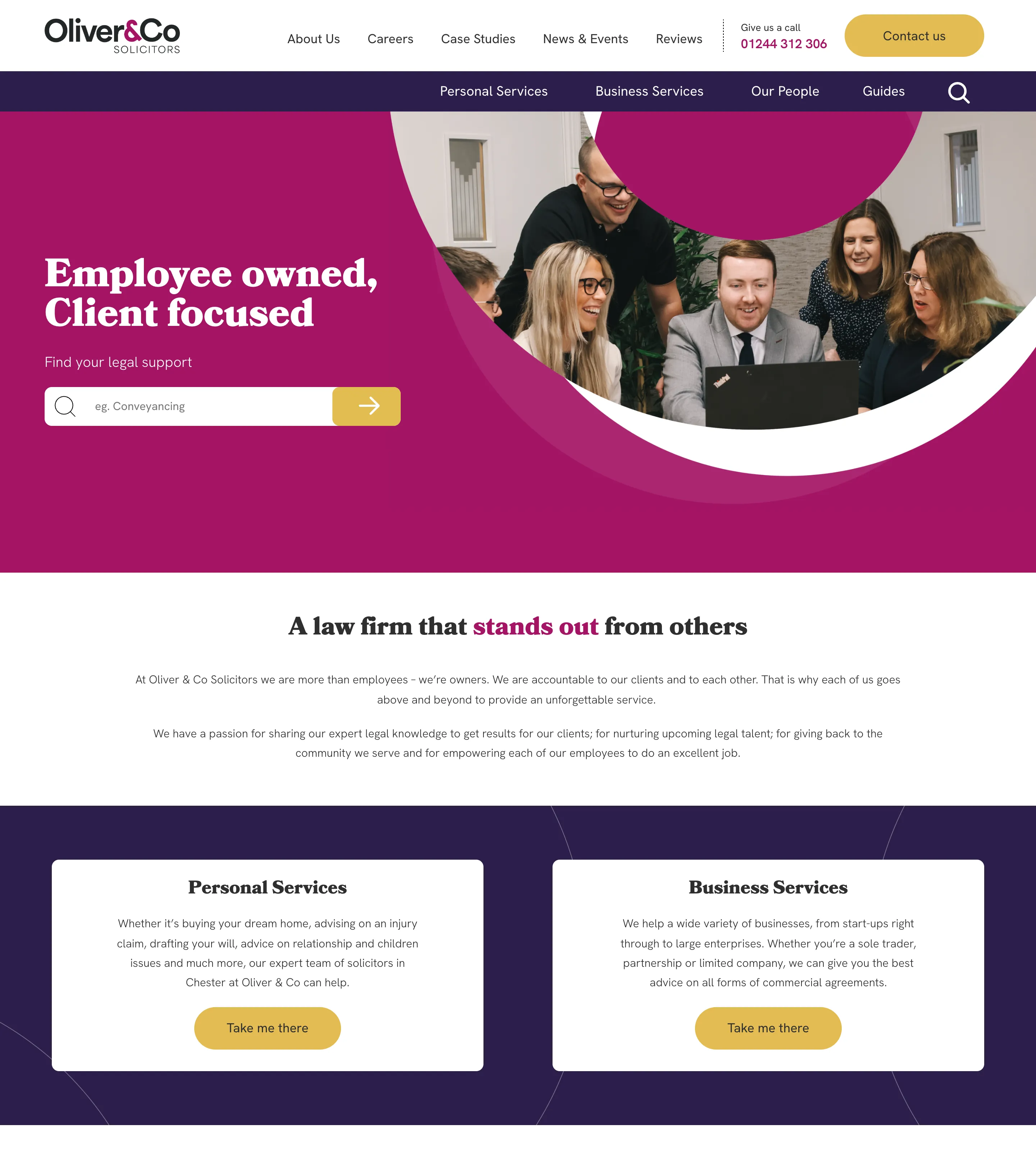
Oliver & Co, Chester. Law firm websites tend to go grey and cautious. This one opens on a magenta hero with a team photo in a curved frame, and instead of a slogan and a button it offers a search box: find your legal support, with conveyancing as the example. Most visitors arrive with a specific problem, and the design meets them there. The phone number sits in the header with a “Give us a call” label, a bright mustard “Contact us” button sits beside it, and the deep aubergine and mustard palette gives a serious profession some warmth without losing its credibility.
Neither site relies on an effect you could not build in an afternoon. Both are carefully designed. The care just goes into the job, not the show.
What a local business gallery should judge instead
If the problem is what galleries reward, the answer is a gallery that rewards something else. That is what Ordinary Websites tries to be. Every site in it is live, belongs to a real, currently operating independent or local business, and is chosen on how well the design does its job: clear services, an obvious call or booking action, trust signals and a good mobile experience.
It is also platform neutral. A site built on Squarespace sits next to a custom build if it does the job better, because the customer on the other end never knows or cares. And every site is dated by when it was captured, because local sites change and an honest archive should say so.
None of that makes a better showcase. It makes a better reference library for the work most designers actually do.
Start with the right references
If you build for local and service businesses, start with sites that solve the same problems yours do. Browse restaurants, clinics, accountants, gyms and fitness studios and more, and for a practical method, see how to find web design inspiration for clients in “boring” industries. Every Friday, the newsletter sends five of the best new finds.
Frequently asked questions
Why don't design galleries feature small business websites?
Mostly because nobody enters them. Showcase galleries are fed by agencies and designers putting forward their own work, and judged on craft and novelty. Local business sites are rarely entered, and their best qualities, like a phone number that is always in reach, do not stand out in a showcase.
Where can I find web design inspiration for local businesses?
Look at real sites from the same trade in other cities, and at other industries that do the same job, such as a spa and a dentist that both live on bookings. A gallery that collects local business sites by category, like Ordinary Websites, saves most of the digging.
Is a showcase-winning website good for a small business?
Not necessarily. Showcase sites are judged on craft and originality, not on whether they bring in calls or bookings. Some techniques carry over well; heavy animation and unusual navigation usually do not.
Should designers who build for local businesses enter showcase galleries?
There is no harm in it, but do not let it shape the work. A local business site is judged by its customers, in a few seconds, on a phone. Design for that first.